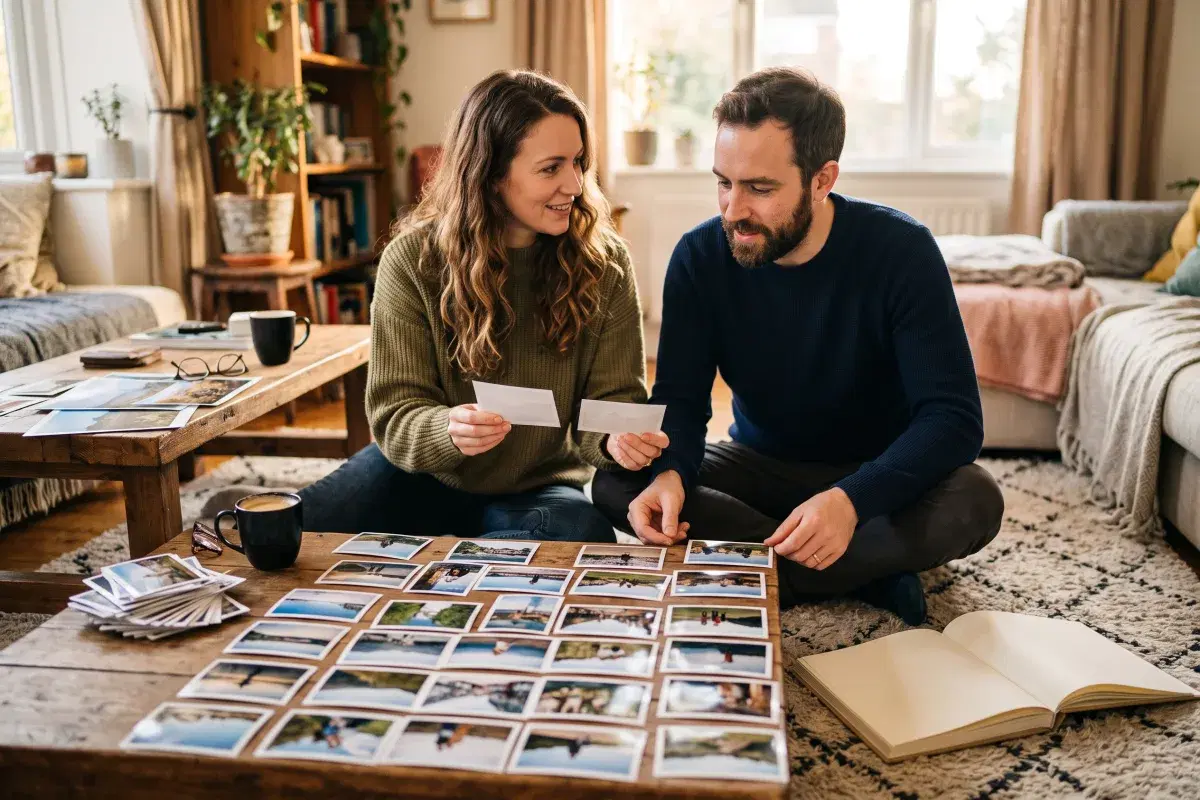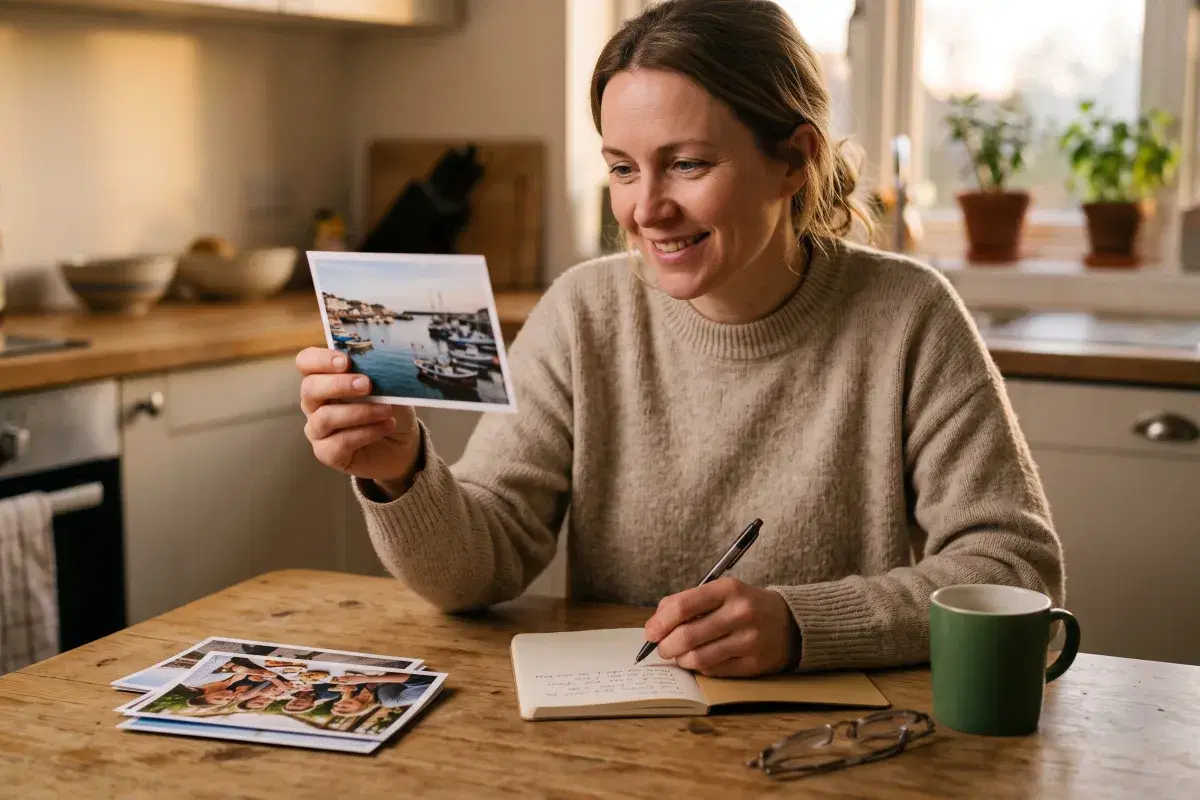
You have the book laid out. Thirty-odd photos sit in the right order, the cover is chosen, and under every photo there is an empty caption box. You type "Harbour, day 3" into the first one, look at it, and realise it tells the reader nothing the photo did not.
This guide is for the person at that point: the book is nearly done, and the words are the part left over. Most people either skip captions or fill every box with a place name. Both produce a book that looks finished and reads like an index.
The fix is not better writing. It is knowing what a caption is for.
A caption says what the photo cannot
A photo already shows where you were, what the light was doing and who was in the frame. A caption that repeats any of that spends the reader's attention on nothing.
What the photo cannot show is everything outside the frame and everything after the shutter: what happened just before, what someone said, why you stopped the car here, what went wrong ten minutes later. That is the material a caption exists to carry, and it is the first thing to fade from memory.
Take one photo of a cliff path and three possible captions:
- Cliff path, day 2. A label. The reader could have written it.
- The cliff path above the cove, Wednesday morning. Where and when. Useful as an anchor, still not a reason to look twice.
- Two hours in, Sam remembered the car keys were back at the trailhead. The moment. Nobody who was not there could write it, and everyone who was will laugh at it in ten years.
Write the third kind. Keep the second kind only where the reader needs to know where they are.
Caption the day first, then the photos that need it
You do not need a caption under every photo. You need a short paragraph per day and a line under the photos that carry a story.
Start with the day openers. Two or three sentences for each day: where you started, where you ended, and the one thing that made it different from the others. Read in order, the openers become the trip's narrative, and they are easier to write than photo captions because a day always has a shape.
Then go through the photos and caption only the ones where something happened that the frame does not show. On most trips that is about one photo in three. A full-bleed landscape needs nothing. A table of six people mid-laugh almost always needs a line.
Write from a record, not from memory
The hard part of captioning is not phrasing. It is remembering which evening the ferry was cancelled, and what the dish was called, three weeks after you got home.
So caption against a record: the itinerary, a notes file, the group chat. Put the photo next to the day's plan and the plan jogs the memory. Dinner was booked for 7:30, the photo is from 9:15, so something changed, and that change is the caption. If the camera roll is still a mess, fix the timestamps and sort by day first, because a caption written under the wrong day is worse than none.
MyTripLogix helps you caption a book from the trip you actually took by filing every photo against its day and stop, by timestamp and GPS, as you upload, so each caption box already sits beside the plan it belongs to. On Pro, AI captions draft the where-and-when line from that. The sentence about the car keys is still yours to write.
Keep each caption to one or two sentences
Book captions are read in passing, with the book open on someone's lap. Past two sentences a caption turns into a paragraph the reader skips.
- Name people. "Sam", not "a friend". The book will outlive everyone's memory of who was there.
- One detail beats three adjectives. "The bread came in a paper bag, still warm" beats "a lovely, cosy, rustic bakery".
- Cut the photo, not the caption. If a caption needs a second paragraph to land, the photo probably needs to go instead.
Why fewer captions make a better book
A 20-page book for a five-day trip holds about 31 photos, as the page arithmetic for a travel book works out: 2 front pages, 5 day openers, 13 photo pages at two photos each, plus the 5 opener photos.
Caption every one of those and you are writing 31 captions, most of them labels because there was nothing else to say. Follow the approach above and the job is 5 day openers of two or three sentences each, plus a line under roughly one photo in three, which is about 10 captions. That is 15 pieces of writing instead of 31, and every one of them has something in it.
Fifteen short pieces is one evening with the itinerary open beside you. Thirty-one written from memory is the version that gets put off until the book never goes to print.
Start with the days you already planned
Captions that carry the moment come from a trip whose days were written down before it happened. Start free and build the trip's itinerary on the free plan: the days you plan become the book's chapters, and every caption has a day to hang on.
Frequently asked questions
Should captions be written in first person or third person?
Either works as long as the whole book uses one. First person plural suits a book for the people who were on the trip. Third person with names suits a gift for someone who was not there.
Is it better to write captions during the trip or after?
During, if you can manage three words a day in a notes file. Those notes are what the captions get written from later, and a rough note from the day beats a polished sentence written from memory a month on.
Should the day openers and the photo captions say different things?
Yes. The opener tells the shape of the day, where it started and ended and what set it apart, while a photo caption covers one moment inside it. If a caption repeats the opener above it, cut the caption.
Do captions in a photo book need to be complete sentences?
No. A fragment such as "Rain, again, and nobody cared" reads well on a page. What matters is one specific detail and the same tone from the first chapter to the last.