
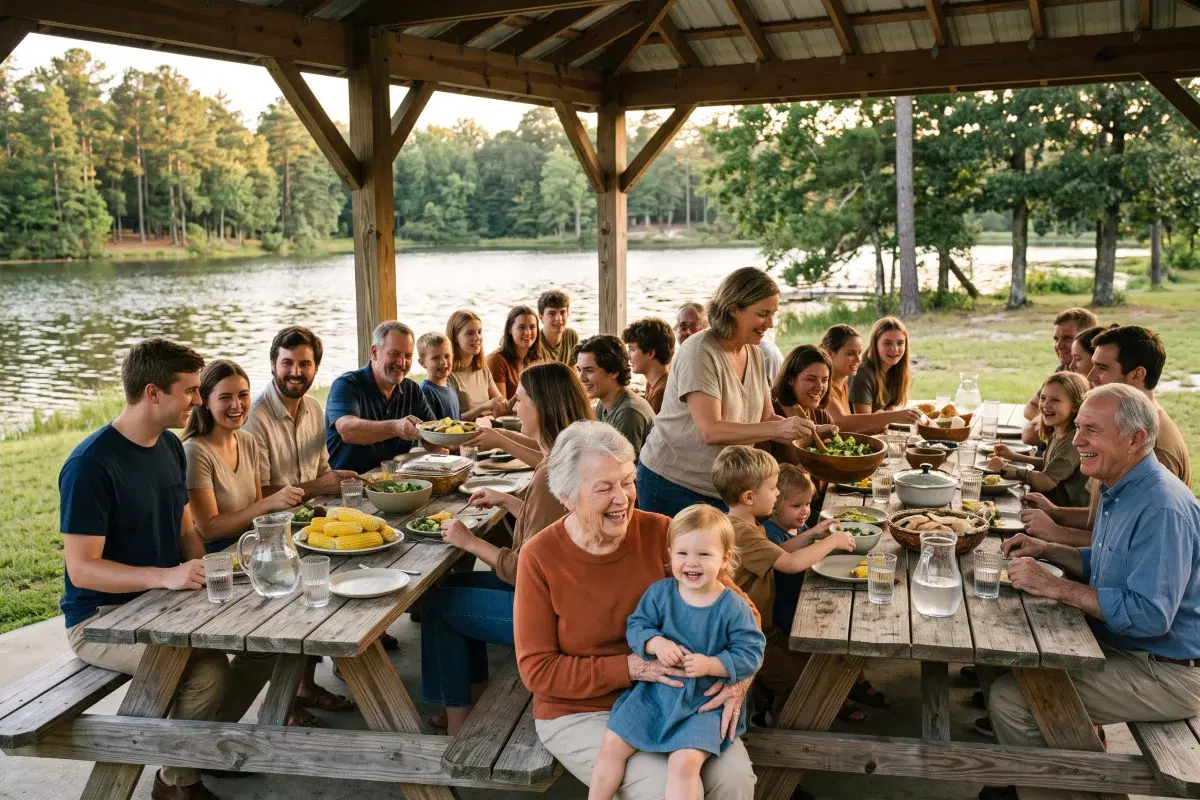
Three weeks before the reunion, your phone turns into the information desk. An aunt wants to know what time Saturday starts. A cousin asks whether the lake house has a grill. Someone's husband asks for the address for the third time, and your mother forwards you a screenshot of a message you sent last Tuesday.
This guide is for the one relative who ended up organizing the reunion: twenty to forty people, six to ten households, a long weekend at a rented house, a park pavilion or a grandparent's farm. You are not short of goodwill. You are short of one place where the plan is written down, so every question comes to you.
The fix is not a better group chat. It is a plan that lives outside your head, organized the same way the weekend is: by day.
Put one person from each household in charge of their household
A reunion is not thirty individuals. It is eight or nine households, each with its own car, its own arrival time and its own reason for leaving by noon on Sunday. Plan at that level.
Ask each household for one lead: the person who already books their family's travel. The job is small and specific. They check the plan, correct what is wrong for their household, and answer their own people's questions. Your job shrinks from answering thirty relatives to keeping eight or nine leads current.
Keep the circle that edits the plan small. Everyone needs to read the schedule. Not everyone should rearrange it.
Anchor each day on one shared meal
Most reunion weekends have exactly three fixed points: Friday dinner, the big Saturday gathering, and a Sunday breakfast before people scatter. Everything else is optional, and should be written that way.
Give each day one anchor with a time and an address. List the optional things around it, such as the hike, the afternoon at the pool or the trip into town, as stops people can skip without anyone keeping score. A grandmother who sits out the hike still knows exactly when to be at the pavilion.
Write who is bringing what on the meal itself. "Second household: two salads and paper plates" next to Saturday lunch settles a question that otherwise gets asked six different ways in the chat.
Let the longest drive set Friday's clock
The branch of the family driving six hours sets the start of the weekend, whether the schedule admits it or not. If they leave after school pickup at three, they arrive at nine, and a Friday dinner set for six loses a third of the family.
Write each household's drive into the plan as its own stop, with the time. Then build the first evening backwards from the latest arrival, not forwards from the earliest. Sunday works the same way: whoever has the longest drive home decides whether breakfast is at nine or at eleven.
MyTripLogix helps the relative organizing a reunion stop being the family's switchboard by keeping the days, stops and drive times in one shared itinerary that the household leads edit alongside you.
Why a written plan beats a longer group chat
Take a three-day reunion with 28 people in 9 households. Each household needs the same five facts every day: where, what time, who is driving, what to bring, and when it ends. That is 9 × 5 × 3, or 135 answers across the weekend. In a group chat, each answer is given once, scrolls out of sight, and gets asked again.
Written into a plan, the same weekend is 15 facts: five a day, for three days. Each is written once, and nine leads read it. The work you do drops from 135 answers to 15 entries, and the corrections come from the people who know their own household best.
The drive-time step holds up for the same reason. A plan that says Friday dinner is at 7:30 because the longest-driving household arrives at 7 is a plan nobody argues with, because the reasoning is on the page.
Start the reunion plan this week
Once the days, anchors and drive times are written down, the questions go to the plan instead of to you. Start free and build the reunion's itinerary on the free plan: one day for each day of the weekend, one anchor meal on each, and each household's drive as a stop. For the part after the weekend, how many photos should go in a travel photo book is worth a read.
Frequently asked questions
How many relatives can help plan a family reunion itinerary?
Two collaborators on the free plan and eight on Pro. For most reunions that is enough for one lead per household, with everyone else getting their answers from their own household's lead.
Can the reunion photos go into a printed book afterwards?
Yes. Photos file themselves against the itinerary's days by timestamp and GPS as they are uploaded, and the finished trip becomes a printed book whose chapters are those days. Books come in softcover or hardcover imagewrap, and both include 20 pages. The free plan holds 50 photos per trip and Pro holds 500.
Can I plan the reunion and another trip at the same time?
On the free plan you have one active trip at a time. Pro allows unlimited trips and books, so a reunion and a separate holiday can be planned side by side.